Warning: Undefined property: WP_Error::$term_id in /var/www/vhosts/stanislav.si/en.stanislav.si/wp-content/themes/stanislav/archive.php on line 22 HOME > NEWS AND EVENTS >
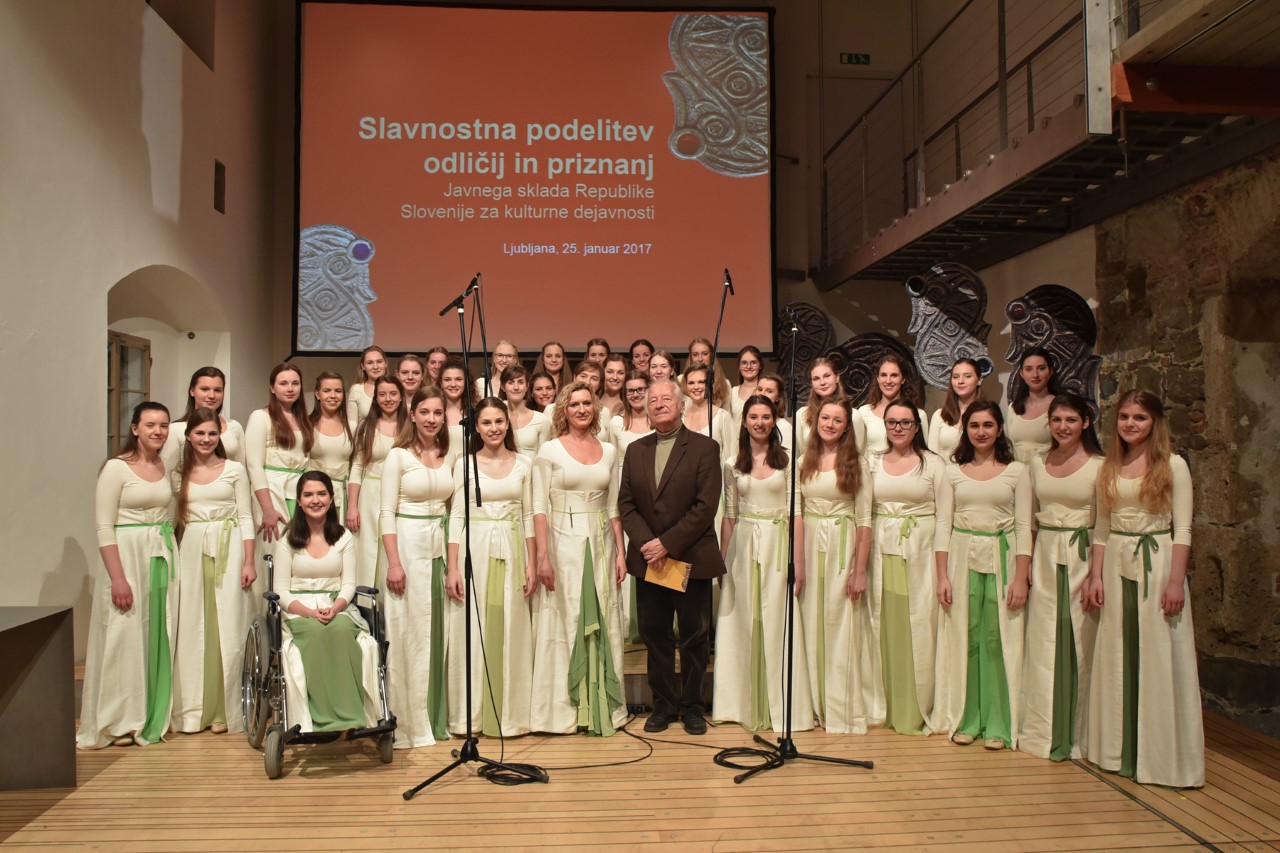
Lojze Lebič with St. Stanislav Girls’ Choir photo: Janez Eržen
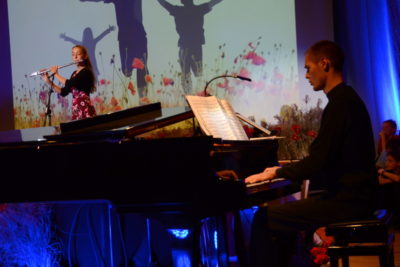
St. Stanislav Girls’ Choir performed on Wednesday, 25th January 2017, on the occasion of presenting Gallus awards in the field of amateur cultural activities. The event took place on Ljubljana Castle hill. The Slovenian Public Fund of Cultural Activities annually awards the deserving musicians. The piece was the song premiere by Lojze Lebič, a contemporary Slovene composer. The composition entitled “Something is in the air” is based on a poem by Tone Pavček, one of the most renown Slovene contemporary poets. The composition is said to be wonderful and inspiring with full of positive vibe. It has brought about so much optimism!
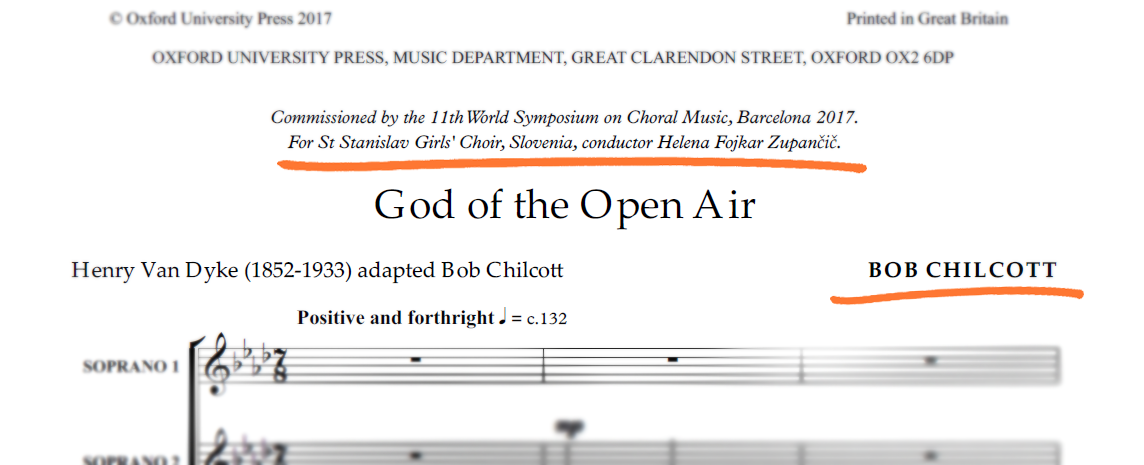
Breaking news: we are thrilled about the brand new piece composed by Bob Chilcott, British choral composer, conductor and singer. It is dedicated exclusively to St. Stanislav’s Girls’s Choir and its conductor Helena Fojkar Zupančič. It bears title God of the Open Air and is based on a heartwarming ode to nature – a poem by Henry Van Dyke (1852-1933), an American author, educator and clergyman.
And what is the conductor’s first reaction? »The piece is exactly up my street! It is wonderful, soft, melodious, lively and airy. I believe this compostition will enable the girls to show all the attributes of their singing and interpreting. What a lovely challenge!«
We cannot wait for the first performance to take place in July at the 11th World Symposium on Choral Music in Barcelona!
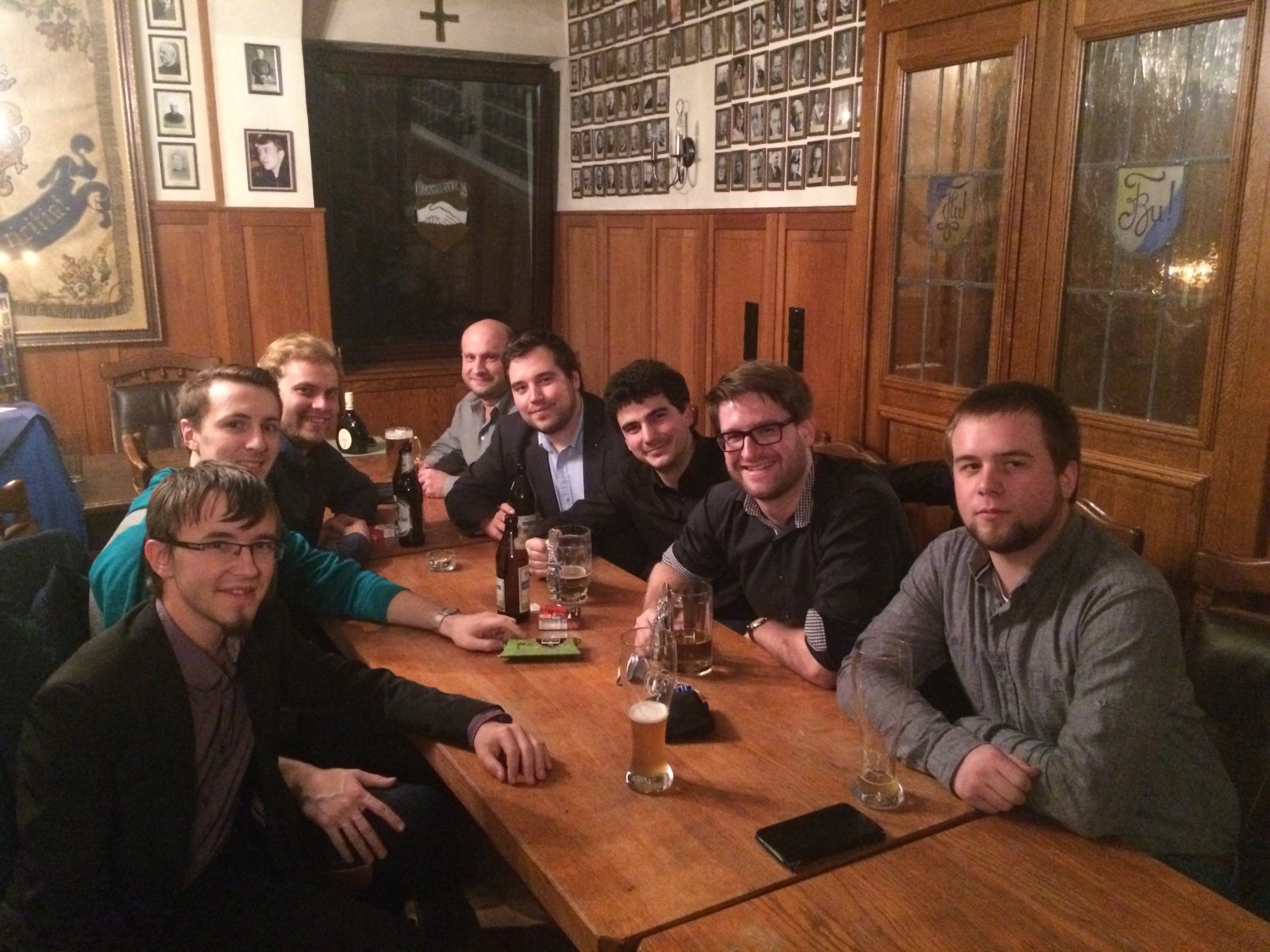
Jan Pintar (first on the left) with fellow students at the “Ankneipe”
Pavel Orešnik, alumnus of The Diocesan Classical Gymnasium (the first generation) is an attorney specialised in German transport, civil engineering and architecture law, with an office in Tettnang, Bavaria, Germany. Pavel is a member of Slovene-Bavarian Economic Club as well as of Academic Society Unitas Würzburg.The latter enabled him to study law in Germany and consequently he has been helping other DCG students ever since to pursue their studies in Germany. This year the opportunity was offered to Jan Pintar, who graduated at the DCG in July 2016. Irena Bolta, teacher of German at the Diocesan Classical Gymnasium and Pavel’s class teacher, has been in charge of the link with Society Unitas since its very beginnings in 1997.
Jan Pintar is the third student of the Diocesan Classical Gymnasium Pavel has assisted so far in this matter. Jan, after successfully passing a comprehensive test DSH (Deutsche Sprachprüfung für den Hochschulzugang) has taken up socio-political studies at Bayerische Julius-Maximilians Universität Wurzbürg. Jan says: “A new life started for me in October 2016. I got to learn many new friends and I feel very much at home here. Especially the Academic Society Unitas Hetania Würzburg provides a fruitful environment for a foreign student.” The so- called Ankneipe introduced him successfully to the student community, where he met other freshmen as well as senior members of the club.
We wish Jan all the best in his studies and would like to thank warmly Pavel Orešnik for his kind and steady support to the students of St. Stanislav’s Institution. /Lily Schweiger Kotar/
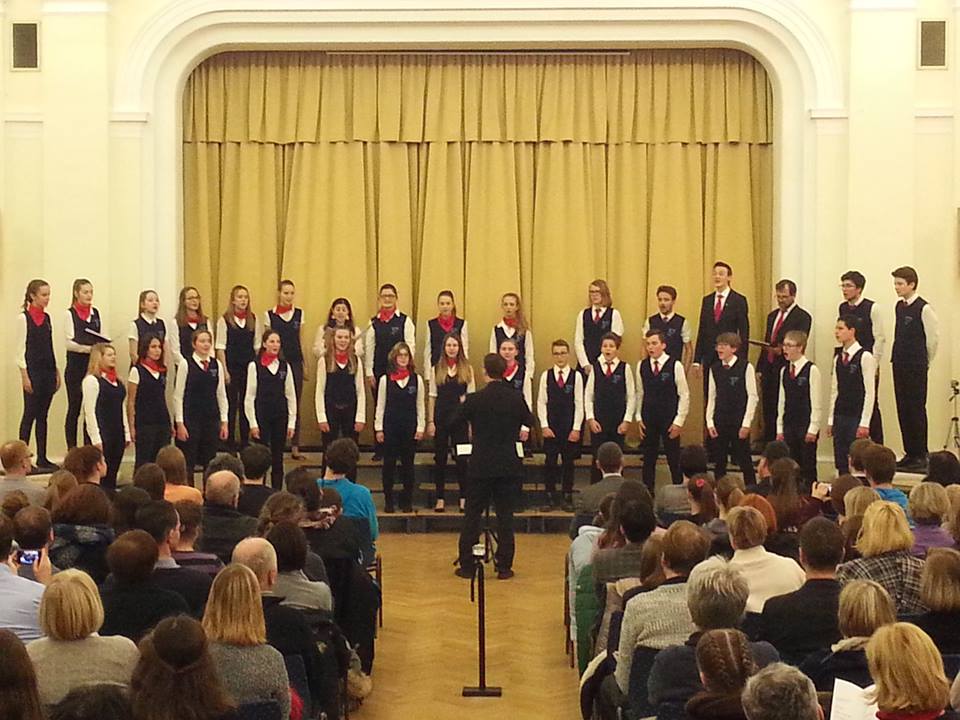
The second choir exchange between Bischgym, the mixed choir from The Bischöfliches Gymnasium Graz and the (Re)Mixed Choir of the Diocesan Classical Gymnasium took place from 10th-12th January 2017. On the first evening the guests took part in the rehearsals for the traditional New Year’s concert in St. Stanislav’s Chapel. The next day they presented themselves to the school community at the lunch concert which attracted many students and teachers. For an energetic performance they were welcomed and rewarded with a loud applause. In the afternoon the sightseeing tour of Ljubljana took place, during which some even went up the castle hill to admire the stunning winter view of the capital city. After the common rehearsals, members of both choirs offered an unforgettable singing event. To start with, Matija Tomc Hall was packed. The (Re)Mixed Choir of the Diocesan Classical Gymnasium presented itself for the first time this school year and sang same inspiring spirituals as well as the Queen medley for good old rock lovers. The guests came up with some Christmas repertoire, both traditional and modern as well as some eye-catching choreography. Both choirs sang jointly the introductory and closing pieces.
The occasion has proven that the exchanges are a good way to learn new things, broaden horizons and make friends. Most of the hosts welcomed their Austrian friends from last year and were most pleasantly surprised by their peers’ eagerness to see Ljubljana sights, the school and join the common endeavours for a lovely musical experience. Each and everybody invested in the event loads of energy, love for music making and kind understanding to which all member choirs, host families and above all both conductors, Valentin Zwitter and Helena Fojkar Zupančič, are highly beneficial. /Lily Schweiger Kotar/
Voila! The video presentation of St. Stanislav Girls’ Choir on the occasion of their visit to Barcelona is out! The girls have it all: subtle interpretation, colourful sonorities, fascinating creative and vivacious performances, youthful passion with incredible concentration and sound accuracy. So they say. Check it yourselves and simply enjoy!
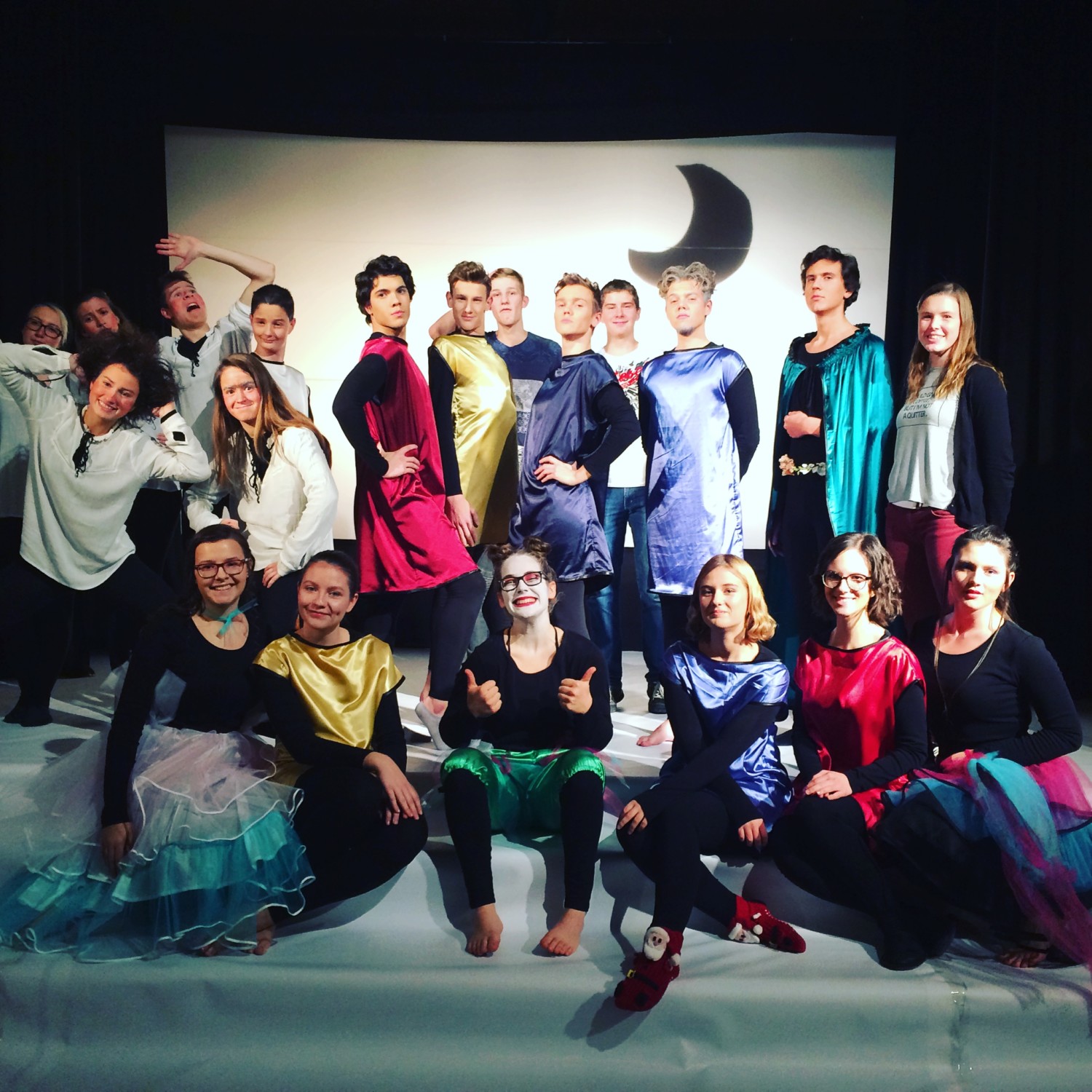
English Drama Club of The Diocesan Classical Gymnasium is staging this year A Midsummer Night’s Dream by William Shakespeare. In this way, St. Stanislav’s Institution commemorates the 400th anniversary of the lasting legacy of the world’s greatest playwright in English language. Twenty-eight student-members of English Drama Club acted in four reprises, which took place in November and December 2016. Among them, there were eighteen actors, six scene artists, two lighting and sound designers, a photographer and a designer of hair and makeup. Thus, the play was entirely in student’s hands, who worked under the mentorship of Alenka Battelino and Mojca Lavrič, who have been with the English Drama Club since 2012. After Oscar Wilde’s Ideal Husband, this is already the second play to in English language at the DCG.
Read more
These are some reflections on the play by Anamarija Mihovec (Year 3), who acted in the play: William Shakespeare. Is there anybody who does not know his name? Not only did he write 37 acts and 154 sonnets, but there are also an enormous amount of new words and phrases he left behind. His works have had a huge effect on writers and literature worldwide. What an honour to act in one of his comedies!
How did it all start?
It all started quite simply, with an invitation over the school loudspeaker. But, let us take it step by step.
The beginnings, the idea. The first meeting was interesting: new faces, new opinions, new friends. Just a little bit about the author himself. A Midsummer Night`s Dream (our aim). First homework (already!): read the play in Slovene and think about the cast. First conversations and discussions, then reading (in quite difficult Shakespeare`s) English. There was (and still is) a lot of text. More than three quarters of it also incomprehensible at first. We did have a Slovene translation that helped us out. If as an actor, you do not know what you talk about, you cannot tell it right, can you? Casting definition. Rehearsals. Learning the text by heart (some have a lot of it, others a bit less).
Rehearsals are underway. I stopped counting them at twenty. (Just kidding). Actually, I did not have to count them. It was a pleasure to be there. Talks in Slovene, then in English and some laughter. The first part of rehearsals consisted of sitting and reading with a book in our hands, the second part were movements over the stage. Every Thursday one hour and a half spent in the company of people who all wanted to put Shakespeare`s work on stage. Slow, but sure progress.
Doubts? Intense rehearsals at the beginning of holidays. First clear “visions” of how the scene should look like. A few problems. Illness, not (yet) knowing all the words, bad mood (not a lot, of course!). We still tried to pull it all together and do our best. And that`s how it progressed – a bit better every time.
Talks about the costumes and hairstyles. A lot of ideas. Brain storming. Scribbling notes. The main idea of simplicity, black leggies and shirt, in different colours, depending on the character. “Let the story be obvious!” Hairstyles. Variety of them among actors. A day when we tried on all of them. (Also the day when I scared myself by looking in the mirror. I really adore my hair now.). Whole play. Getting to know the scene (those shades – a beautiful idea, if you ask me.). We all hoped it would go well.
Open rehearsal. First group photo. Back to play. A huge surprise – a nice one – for all of us. A thrilled crowd (I`m joking, it was not really a crowd), but those ten who did watch the play were thrilled. That provided us with fresh energy. One last practice before the premiere.
The first night. Just a little bit of stage fright. Improvising. Every time we liked it a little bit better. First critics. We were pleasantly surprised by the good ones. Different aspects, different opinions.
Play reviews by some actors and visitors
“When I watched A Midsummer Night`s Dream for the first time I had no expectations. I was pleasantly surprised. The first thing I noticed was the scene, which was quite minimalistic. The floor and background were white and the only thing in the background were the shades of tree leaves and mushrooms. Nevertheless, it was clear what the scene presented and the audience was made to concentrate on the play. As a photographer, I especially liked the lights. They made the scene rather three-dimensional. Thanks to Slovene up-titles, the audience can understand the play despite original Shakespeare’s English. I kindly recommend watching the play to everybody – theatre lovers and beginners; the play catches your attention from the very beginning until you realise it`s over!” Andraž Novak; photographer
“I have participated in the play three times already, but I have never really watched it. I have always been working backstage and tried my hardest for the scene to look great. As I heard, the play is dynamic and interesting. I can hear that the actors are really trying their best.” Ajda Kok, scene artists
“I starred “Nick Bottom” in the play. I was, at least others said so, the star of the night. I couldn’t really say that I stood out. (…) Anyway, I am happy about the play. It was my first big theatre experience. “You know, theatre is not the only stage-managed thing in life. It`s one of the many that tells it publicly and with pride. Life is a play. The Earth is our stage and we are actors. Every day we put on a different mask, trying to convince our friends and peers that we are cool enough, teachers and co-workers that we are smart, employers that we are very capable and a parish priest that we are loyal to God and devoted believers. We even get so accustomed to our masks that we cannot take them off and the face we look at in the evening is not us anymore … think about it… Do you really need to be a theatre actor to learn how to act? I absolutely disagree. I challenge you to prove me wrong…” Luka Benedičič, “Nick Bottom”, actor
“A Midsummer Night`s Dream in the interpretation of The English Drama Club of DCG was a unique experience. Excellently-prepared actors upgraded the original and always actual Shakespeare’s play. The interpretation, which is with this playwright always important) was first-class and represented a quality “theatrical” experience. Personal engagement of everybody involved should be emphasised. Especially the actors were well prepared and got accustomed to the roles taken, which resulted in an outstanding performance. Thus, acting was a key element in excellent characterisations and differentiation of characters. All actors formed on stage a convincing, effective and quality lot, though the scenery was occasionally too dry for me. Definitely worth visiting.” Rok Jan Špiletič, theatergoer
Fin
Maybe the most important opinion of the main directors, A. Battelino and M. Lavrič. They thought it was good. They deserve the biggest “thank you” of course! One can do everything, if you really want to. Happy audience. The feeling of satisfaction, after all the input it was worthwhile. (Cake for everyone!). Hugs. We are one little family. It passed way too fast. That`s how our early winter day’s dream is ending. Say that Shakespeare is boring or too hard, if you dare! /Anamarija Mihovec, year 3/
Christmas Light by Rok Pogačar, Counsellor at The Jeglič Student Home
»Those who walked in the dark have seen a bright light. And it shines upon everyone who lives in the land of darkest shadows. A child has been born for us. We have been given a son who will be our ruler. His names will be Wonderful Advisor and Mighty God, Eternal Father and Prince of Peace.« (Is 9,1.5)
May these festive days strengthen our desire for the light and peace. Allow the light of the newborn Jesus to illuminate the darkness of our lives and fill us with the joy of life and open our eyes, heart and hands for the needs of our neighbours.
I wish you all Merry Christmas and a Joyful New Year 2017.
On November 30, twenty-nine students from the Diocesan Classical Gymnasium participated in the European online English Language Competition Best in English for the first time. They were more than eager to grasp the opportunity to compare their English language skills with those of 15 107 European peers coming from 683 schools and 28 countries. The test fulfilled the needs of students of all years and abilities.
Today we are delighted to announce some really impressive results of our students. The most outstanding achievement of Tinkara UršičFratina from 3C class, who held the 42th place, was just the best among other impressive results obtained by Nika Knez, Nina Katarina Štular, Mark Loborec, Matic Kotar and Matevž Herič. We offer our sincere congratulations to all our contestants! /Petra Kromar/
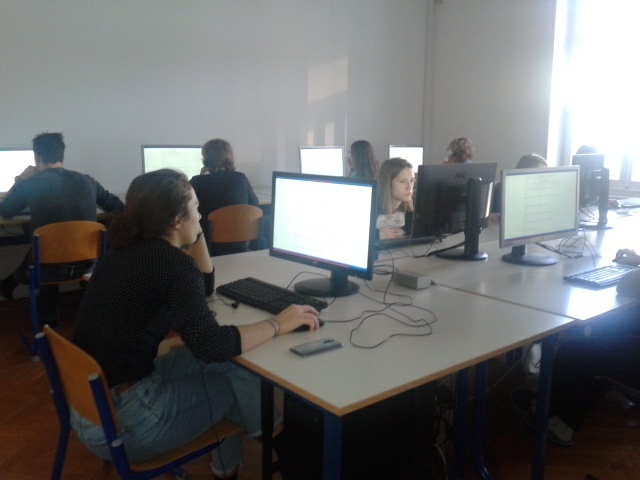
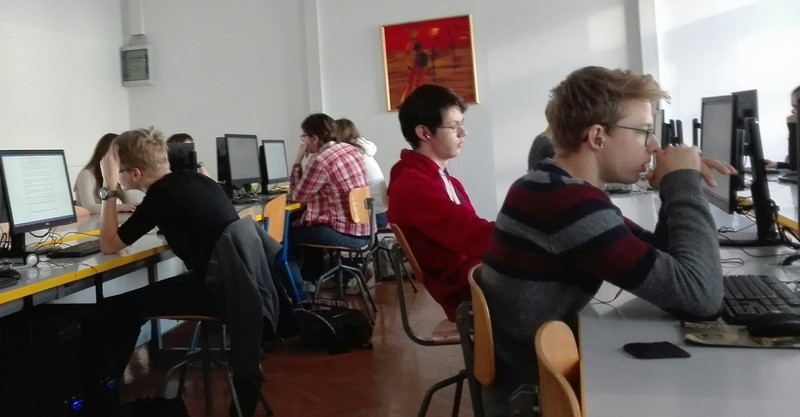
Twenty-nine students from the DCG joined almost 11.000 other students from about 500 schools from all over Europe to compete for the first time at the international competition The Best in English. The event took place on 30th November 2016, it ran smoothly and suited the needs of students of all years and abilities. At nine o’clock sharp participants’ faces got absorbed by the tasks presented on the screens and all one could hear was keyboard typing and mouse clicking. Laughter provoked by up-to-date videos was occasionally heard and generally, a happy atmosphere was created in the classroom.
The teachers of English as well as students believe that this is a lovely way to compare their language skills with those of their European peers. What is more, the test is free of charge and especially students were satisfied with results that appear right away at the end of the contest. In short The Best in English competition is a great European experience. Presently the results are being calculated and we cannot wait to have them announced! /Lily Schweiger Kotar/
The first step into an entirely new world, the first immersion into the sea of words, the first melody – everything is music …
The above verses are taken from the hymn written on the occasion of the 20th anniversary of The Music School in St. Stanislav’s Institution by Primož Bratina, pianist and piano teacher.
The Music School was established in 1996 by the then Archbishop of Ljubljana dr. Alojzij Šuštar. The occasion matches the 200th anniversary of the music education in Slovenia, which is being celebrated this year. In the two decades the Music School has left a remarkable trace and offered countless joyous music events of artistic excellence.
Today The Music School employs 25 teachers engaged in teaching and inspiring about 240 students. Apart from musical theory, sight singing, jazz singing and preschool music, 11 instruments are taught, along with music making in chamber and large string orchestra as well as the guitar ensemble. Teachers devote special attention to students’ creativity. A lot of students excel in competitions at different levels from regional to international, some take in music as a professional path in their lives and continue studies at music academies at home and abroad.
To commemorate the 20th anniversary of the Music School several events will unfold. The solemn celebration to honour the patron’s day of St. Stanislav’ was already set up on 15th November by the staff of the music school and understandably music played an important part. If you missed it, another concert will be put on in the Slovenian Philharmonic on 1st December 2016 at 6. p.m. This will offer another opportunity to listen instrumentalists, singers, guitar ensemble and to Bratina’s Hymn accompanied by four choirs and the large string orchestra. What an appropriate was to celebrate the life of a music school – with music touching everybody’s heart! /Lily Schweiger Kotar/
Warning: Undefined property: WP_Error::$term_id in /var/www/vhosts/stanislav.si/en.stanislav.si/wp-content/themes/stanislav/sidebar.php on line 132
Latest posts under Warning: Undefined property: WP_Error::$cat_name in /var/www/vhosts/stanislav.si/en.stanislav.si/wp-content/themes/stanislav/sidebar.php on line 136
: