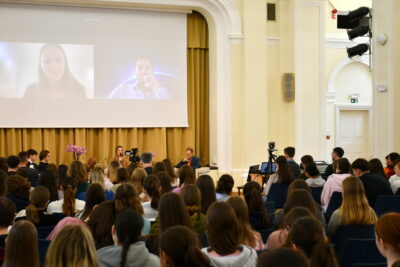
These words by Mark Boris Andrijanič capture the main message of the round table discussion held on Wednesday, April 1, 2026, organized by Škofijska strela at the Diocesan Classical Gymnasium (DCG) in St. Stanislav Institution. The discussion focused on opportunities for studying at universities abroad. The guests included: Zala Tomašič, a political scientist and sociologist, alumna of DCG and Cornell University (USA), and Member of the European Parliament; Jerneja Koren, an alumna of DCG, who completed her Master’s degree in Pharmacology and Immunology at the University of Aberdeen (Scotland) and is currently pursuing a PhD in biomedical research at the University of Basel (Switzerland); Mark Boris Andrijanič, a lawyer, alumnus of DCG and the University of Oxford, he served as Slovenia’s first-ever Minister of Digital Transformation; and Rok Sekirnik, a chemist, alumnus of the University of Oxford, and president of ASEF, a non-profit organization supporting the education of highly talented students and scolars in Slovenia.
The discussion engaged with questions of a more personal and developmental nature, such as what kind of student profile foreign universities are looking for, as well as what studying abroad and such a global experience contribute to students’ intellectual and personal development. Most guests emphasized that they were drawn by the fact that universities abroad seek engaged students who are actively involved in shaping their own curriculum. The discussion also answered many practical questions – the process of selecting an appropriate university abroad, key differences between domestic and international study environments, the principal added value of international study, application procedures for universities in Europe and the United States, funding opportunities, and issues related to accommodation.
During the discussion, the guests – mostly alumni of DCG – also reflected on their former school, considering how their education there had shaped them and prepared them for academic pursuits abroad. They spoke about why it is worthwhile to return to Slovenia after completing one’s studies and the role of the state in facilitating such returns. The discussion concluded on a highly encouraging note. The speakers encouraged the more than one hundred students present to spend at least one year studying abroad, as it is an unforgettable experience that provides invaluable international perspective. They urged them to think carefully about the impact they wish to make with their talents and with what kind of passion they will contribute—whether in Slovenia or abroad—to changing the world. Finally, they highlighted the important role of parents in supporting young people by allowing them the independence to pursue opportunities abroad. /Lily Schweiger Kotar/