Warning: Undefined property: WP_Error::$term_id in /var/www/vhosts/stanislav.si/en.stanislav.si/wp-content/themes/stanislav/archive.php on line 22 HOME > NEWS AND EVENTS >
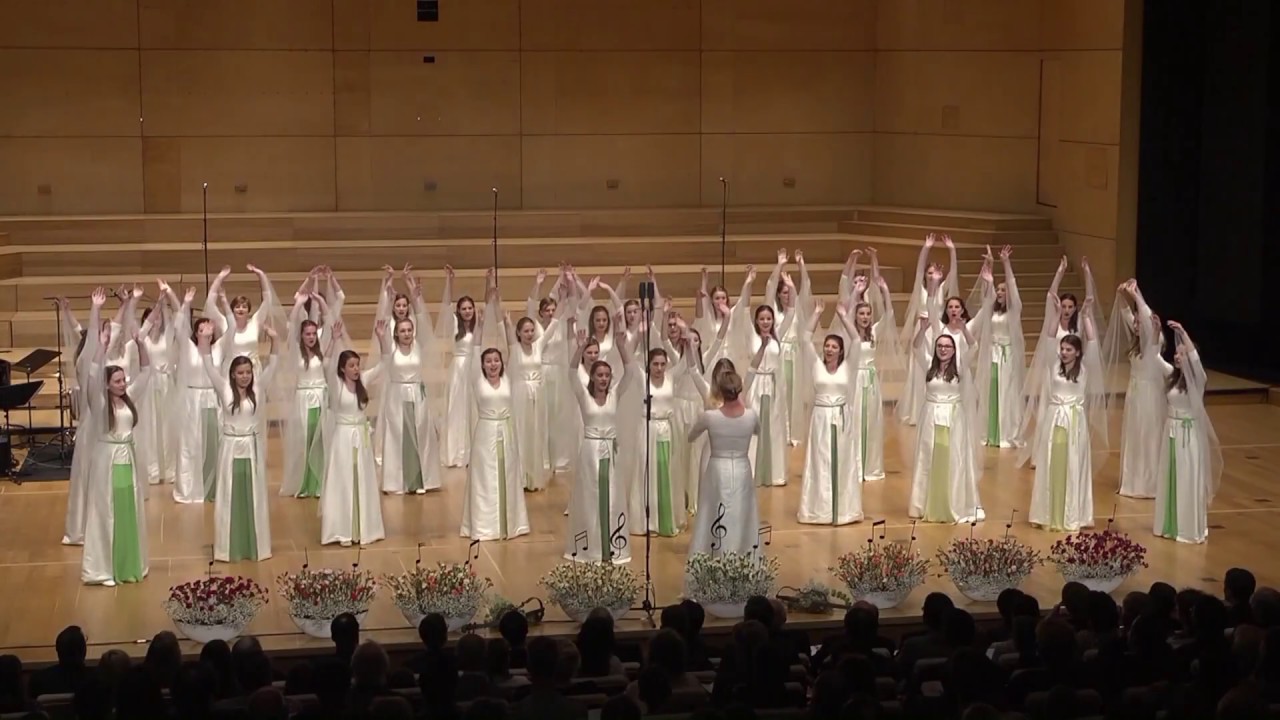
St. Stanislav Girls’ Choir performed on 29th July 2017 at the last two enjoyable and successful concerts of 11th World Symposium of Coral Music in Barcelona.
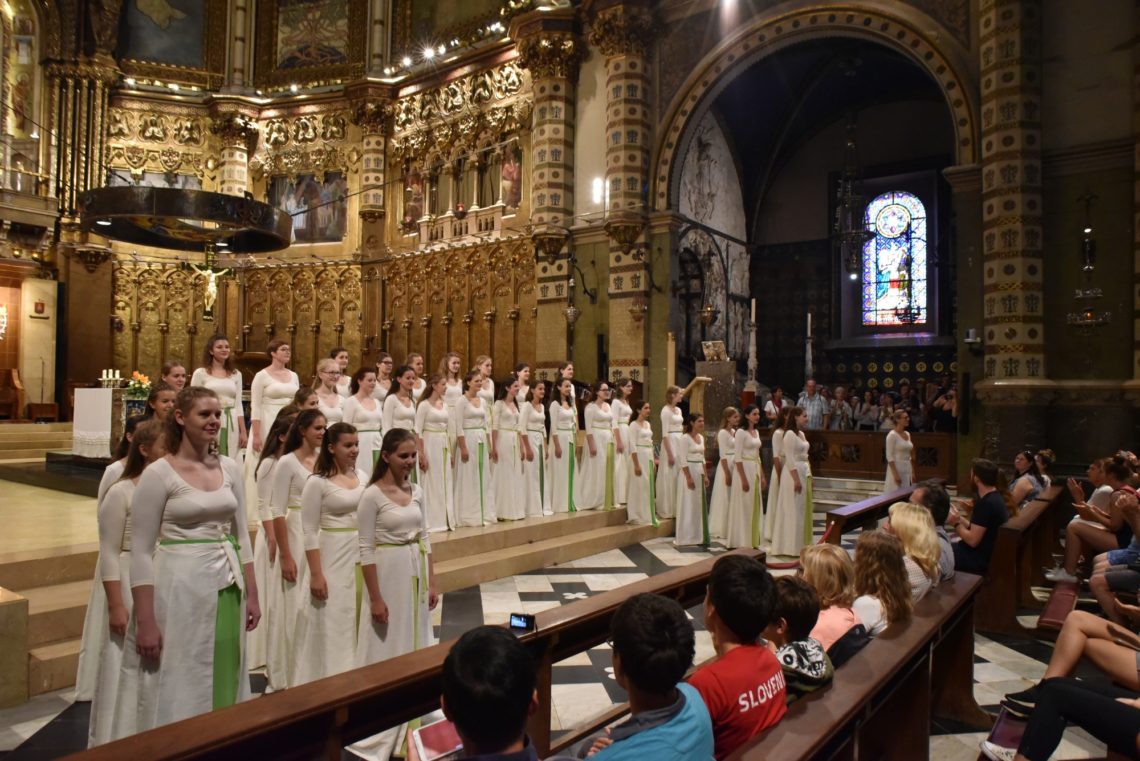
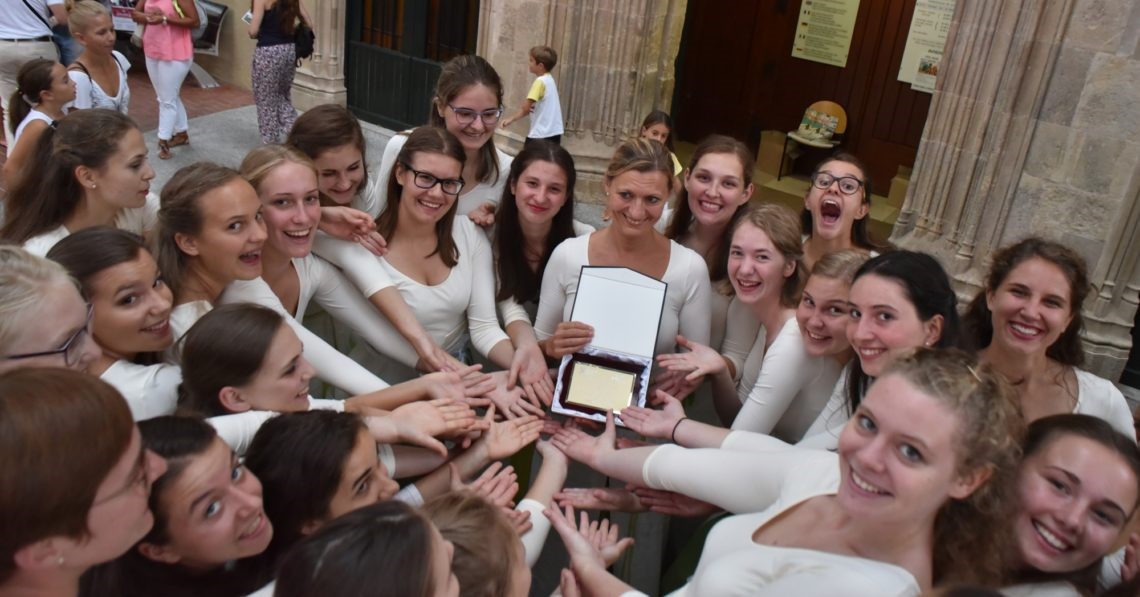
The first concert took place in the most visited Catalan pilgrimage site in Montserrat. Prior to the concert the girls paid visit to Our Lady of Montserrat and thanked Her for all the blessings of the last week, especially for the performances given on the occasion of the world symposium. It was a joy to sing in front of such a large audience – the cathedral was packed with pilgrims from all over the world. Some were so enthusiastic that they even turned up at the final evening concert of St. Stanislav Girls’ Choir, which was given in The Caixa Forum, Barcelona. The choir was quite relaxed on stage, showing their pride over what they had achieved. The incredible vigour was presented throughout the concert: thirty-nine singers, the conductor Helena Fojkar Zupančič and the pianist Primož Bratina were as one. Needless to say, they reached the appreciative audience who enthusiastically gave standing ovations. As after any other concert in Barcelona the girls talked with visitors from all over the world: Chile, Australia, Germany, Singapore, Croatia, Switzerland, Denmark, USA and Slovenia. Again, the girls did an excellent job! Well done ladies!
St. Stanisalv Girls’ Choir – excellency in all aspects
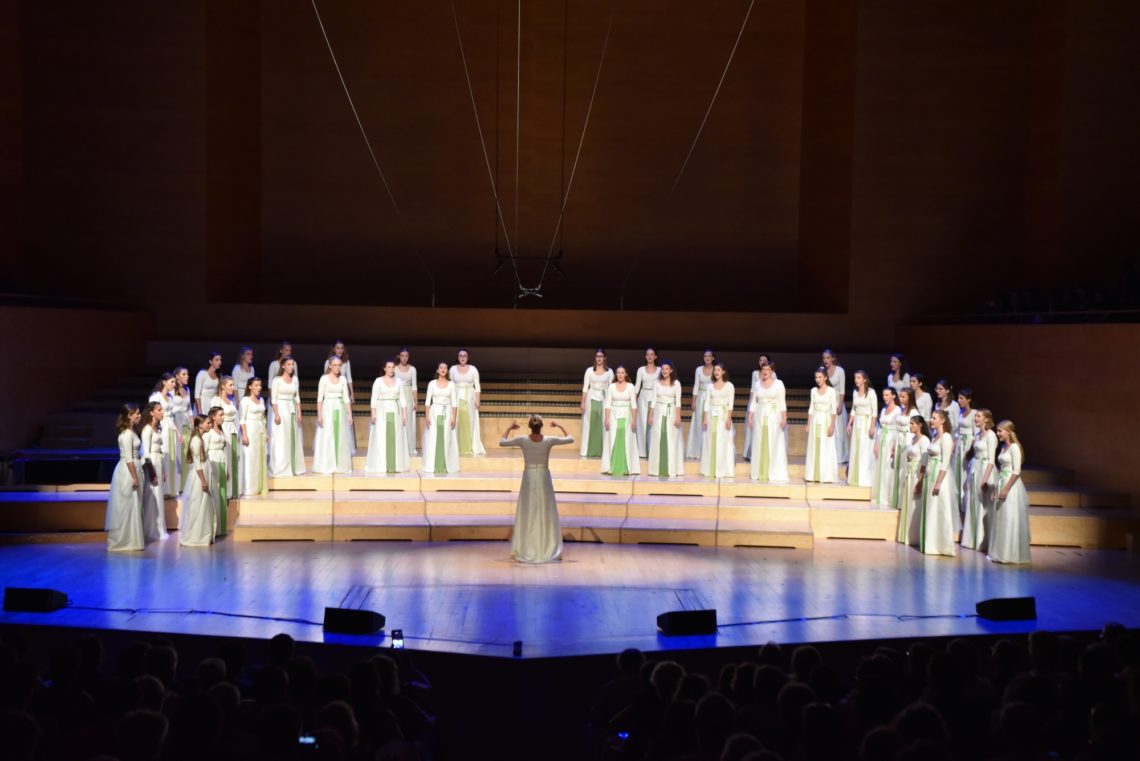
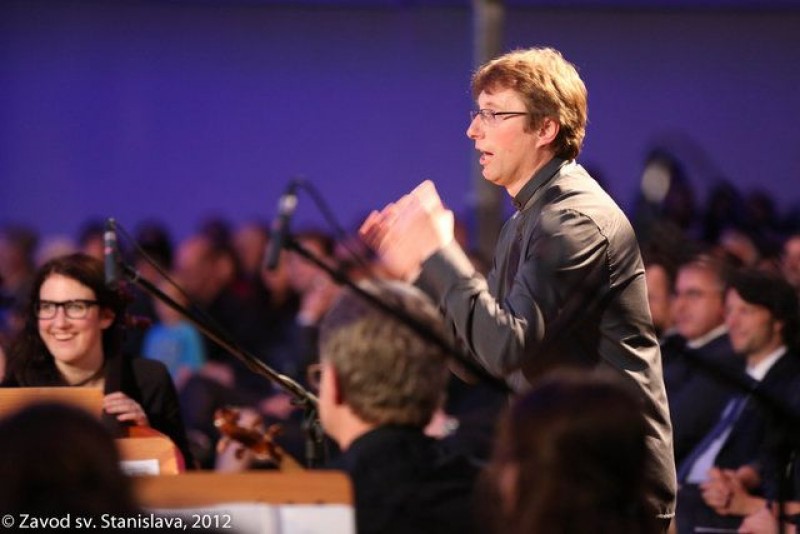
The highly anticipated concert took place on 28th July, 2017 in Auditori, Barcelona. Considering the audience response the event was an unforgettable experience and the girls did a fantastic job! Under the capable direction of Helena Fojkar Zupančič the choir presented the selection of songs, which exceled in versatile style, contemporary features and emphasis on the Slovene choral compositions.
The entire time prior to the concert was dedicated to preparations and final rehearsal details of the highlight of the tour. There was great excitement in the air – nevertheless this was the very first performance of a Slovene choir to sing at any world choral symposium. It was the conductor, Helena Fojkar Zupančič, who broke the ice by singing a verse from a Slovene folk song: God, give us a pleasant evening!, after which the entire choir joined in. Three compositions premiered at the 11th World Choral Symposium, namely Jerusalem by Damijan Močnik (Slovenia), God of the Open Air by Bob Chilcott’s (Great Britain) and My First Angel by Ambrož Čopi (Slovenia). All of them are in one way or other connected with peace, namely peace of mind, God’s peace and peace among religions. Peace is expressed through various musical images and symbols. In this perspective, the choice of programme matched wonderfully the motto of the symposium Colours of Peace.
The audience was thrilled. Each song was accepted with incredible eagerness, especially the world premiere of Jerusalem, composed by Damijan Močnik, composer, conductor and teacher of Music at the Diocesan Classical Gymnasium. He, himself, also present and active at the 11th WSCM, commented on the piece: «What was been created is a picturesque and powerful fresco, which united enormous sound contrasts into a fervent prayer for peace«. It seems the audience was more than touched by the idea of unifying in pledge for world peace, as they all sang along the meaningful words taken form the song: May they prosper who love you. The director of St. Stanislav’s Institution Roman Globokar described the concert enthusiastically as »an explosive mixture of topmost choral know-how, coordinated moves, youth thrill and vigour. The listeners were hit in their hearts.« Standing ovations proved he was right. The girls left the stage moved and teary-eyed, winning together with the conductor high praise for a fantastic choral event.
It is strongly believed that St. Stanislav Girls’ Choir certainly lived up to the reputation of outstanding Slovene choral singing. /Lily Schweiger Kotar/
Breaking the ice is never an easy task. The first concert took place in Lloret deMar. In terms of organisation it was an interesting event and quite an experience; nevertheless, it turned out to be a good practice for concerts to come. Despite not carrying out vocal exercises prior to the concert, it proved to be a success. The audience, among which there were many tourists, was moved by the performance. Some music making took place also after the concert in front of the church and the locals were immediately recognised by several hugs and kisses they bestowed on the girls.
The day ended with some excellent ice cream, bathing in the Mediterranean and a good night’s sleep.
After having sung inspiringly at three successful concerts in Litija, Ljubljana and Koper, St. Stanislav Girl’s Choir set off to the 11th World Symposium on Choral Music in Barcelona. This was the moment they had long awaited for. Needless to mention all the happy anticipation after having worked and practiced hard, scrupulously and intensively especially during last weeks. The girls are in good hands of the following accompanying adults: Roman Globokar, director of St. Stanislav’s Institution; Helena Fojkar Zupančič, conductor; Primož Bratina, pianist and Marjetka Kozmus, music assistant.
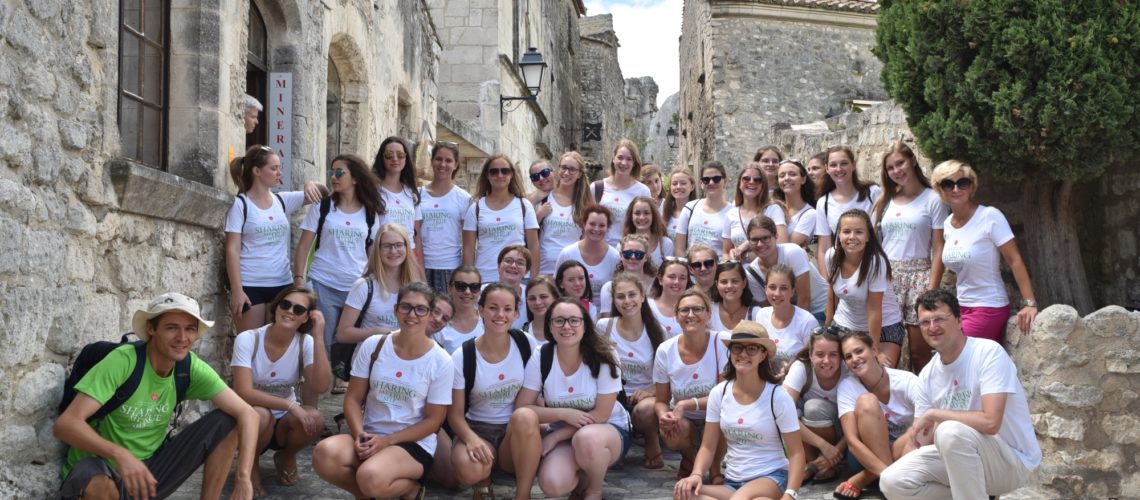
They hit the road in Koper and continued the bus trip through Italy, French Province and finally safely ended up in Barcelona. Especially the stop in Les Baux-de-Provence took their mind off singing and the girls enjoyed to the full the charms of the French Riviera: the stone village perched on a craggy hill, lavender, perfumes and hot sun. Impeccable combination!
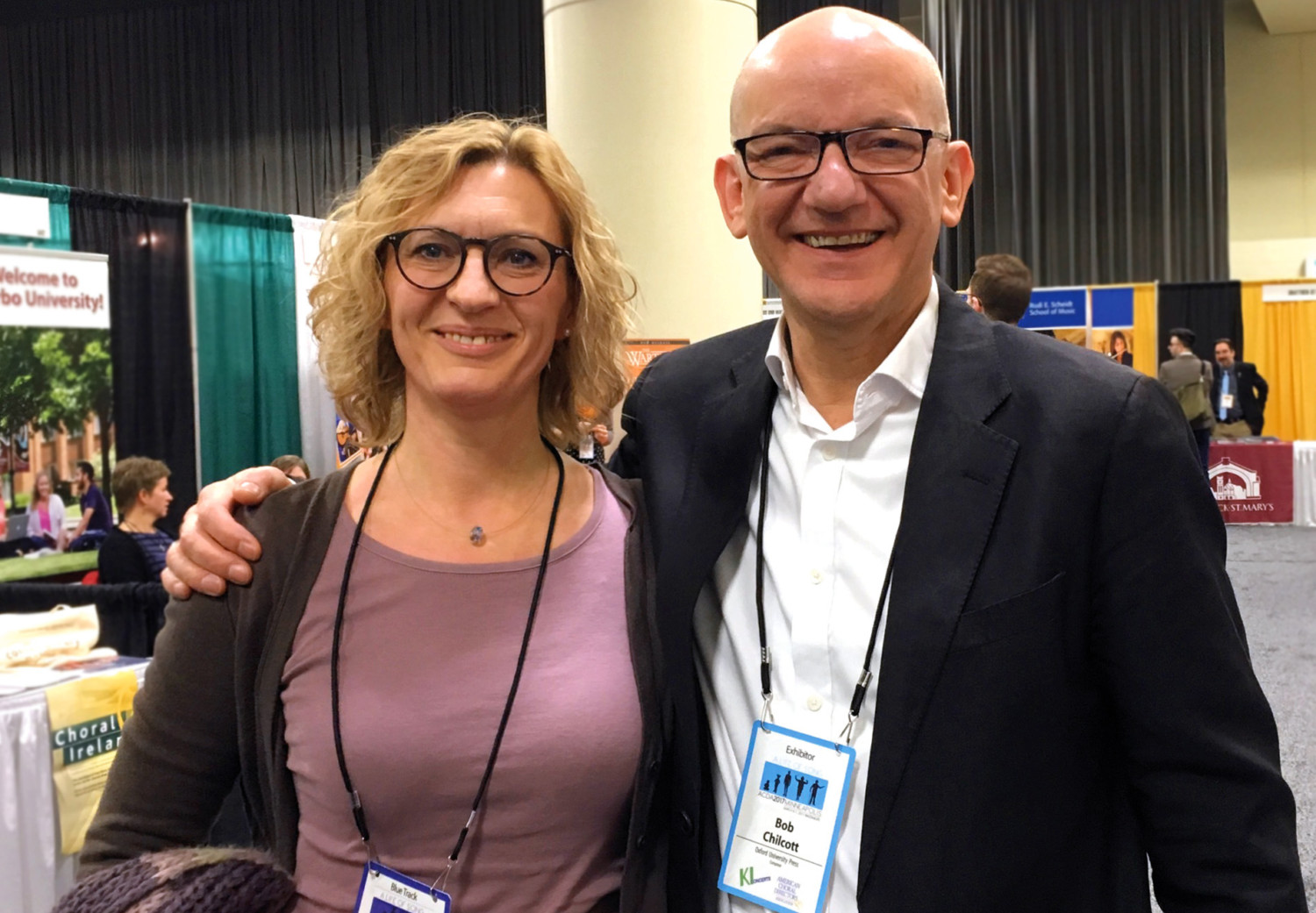
Helena Fojkar Zupančič and Bob Chilcott in Minneapolis, USA in 2017
With these words Bob Chilcott, one of the most active composers and choral conductors in Britain today, pointed to the unifying role music has always had. Chilcott has been involved in choral music most of his life and has poured his energy over the last decade into choral composition, conducting, and promoting choral singing throughout the world. It has been an absolute honour that he wrote a song dedicated to St. Stanislav Girls’ Choir of The Diocesan Classical Gymnasium on their singing at the 11th World Symposium on Choral Music in July 2017 in Barcelona. It bears the title God of the Open Air and is based on a heartwarming ode to nature by Henry Van Dyke, an American poet.
This is how Bob Chilcott kindly appeased girls’ curiosity – and ours as well – in his recent interview. It is a story about Chilcott’s passion for music, commitment to cheerful enjoyment of life and exultation of spirit.
“I love the freedom of composing.”
Chilcott writes choral and orchestral pieces, but he loves to write music with words, as poetry is another passion of is. He started off as a composer when he was eight years old and went away to choir school and sang every day in a college chapel in Cambridge. He wanted to write the kind of music he sang. Much later, at around 40, he began writing music for upper voices, mainly for young singers. He explains: “I think that the freedom of composing gave me energy which is reflected in quite a lot of the music I have written for upper voices and that has been very important for my work”. As to his inspiration for music writing Chilcott admits the piano played an important role: “I learned the first movement of the Sonatine by Maurice Ravel on the piano and also the second piano prelude by George Gershwin and I thought, I want to write music like that!” It is almost impossible for him to decide which of his composition he likes best. In a way, they reflect his life as it was when he wrote each piece, and this can be both good and bad. However, the work he is most proud of is his large setting of the St John Passion, written in 2014.
One’s private life is always mirrored in human’s creations. Chilcott explains that when you are a musician it is very hard to switch off from music. When he is writing a piece, he thinks about it all the time, so it becomes very much a part of his private and family world. “I love children, I have five of them, and I have always had a childish mind! I also like communicating, and I think all these things are reflected in my works.”
“Music is a thing of great beauty that needs to be learned and loved”
Both the performers and the listeners are always effected by music. That is why he likes live events best and believes that the link between singers and audience is very important. One of the great things about performing is to try and make this connection, as music is so important in our lives. It is a thing of great beauty that needs to be learned and loved. He believes young people have today so many choices when it comes to music – the important thing is to identify with the kind of music you love and work at it.
God of the Open Air: “I wanted it to be positive and honest.”
Chilcott admits he was thrilled to discover he would be writing a piece for St. Stanislav Girls’ Choir! “I love the sound and energy of a choir like yours”. In the first place, he was looking for a piece that had a good message bursting with energy. He ended up finding this in a poem by Henry Van Dyke (1852-1933), an American author, educator and clergyman. God of the Open Air is a setting of a part of that poem. It took him around a week to write the song. “Normally I think about the piece for a long time and the writing of it then happens quite quickly.” The asymmetric quality of 7 and 5 in a bar pattern appeals to him as when they are quick they can have a pressing urgent feel, which he likes.
First impressions after having listened to the interpretation of his song? “I was thrilled to hear that you sang it much as I imagined it. That is always very touching, because it gives me the feeling that even though I have never met you, we have together managed to make a connection. It is a beautiful connection, because my idea becomes something that you identify with and make your own. That is one of the many magical things that music can do. Thank you!”
Girls’ questions answered in brief:
Did your parents always encourage you to work with music? “They were not musical, but they encouraged my love of music for which I am very grateful.”
Do you sing yourself? “I used to be a singer. I sang for 12 years till 1997 with an English group called The Kings Singers.”
Who is your favourite composer and why? “That’s a very difficult one! I love many composers, the English Renaissance composer Thomas Tallis, and the Hungarian composer Gyorgy Ligeti. In addition, I love Rachmaninov (particularly the 3rd Symphony and the Symphonic Dances,) and I also love the Austrian composer Gustav Mahler. I also love Brahms!”
If music were colour, which one would it be? Why?“Different ones, probably blue, but also yellow, which is my favourite colour!”
What do you do in life, apart from music writing of course? “I love sport. I used to play football, and I love the game. I also skip (like a boxer!) every morning for 20 minutes. I have done this for the past 9 years. I used to run. I also like to read novels, and I love to cook as well.”
Which music is particularly dear to your heart? “I love many different types of music. I like to listen to renaissance English Choral music (there is an English group called Stile Antico, who sing this music beautifully, and I have many of their CDs.) I love German lieder (particularly Schumann). I am a big fan of the Chinese pianist Yuja Wang, who has a beautiful anarchic energy, which I really like, and she plays the piano brilliantly. I also love jazz. The American pianist Herbie Hancock is a great favourite of mine. I like jazz/funk as well, particularly the American group The Yellowjackets, who I was lucky enough to work with last year. /girls from St. Stanislav Girls’ Choir and Lily Schweiger Kotar/
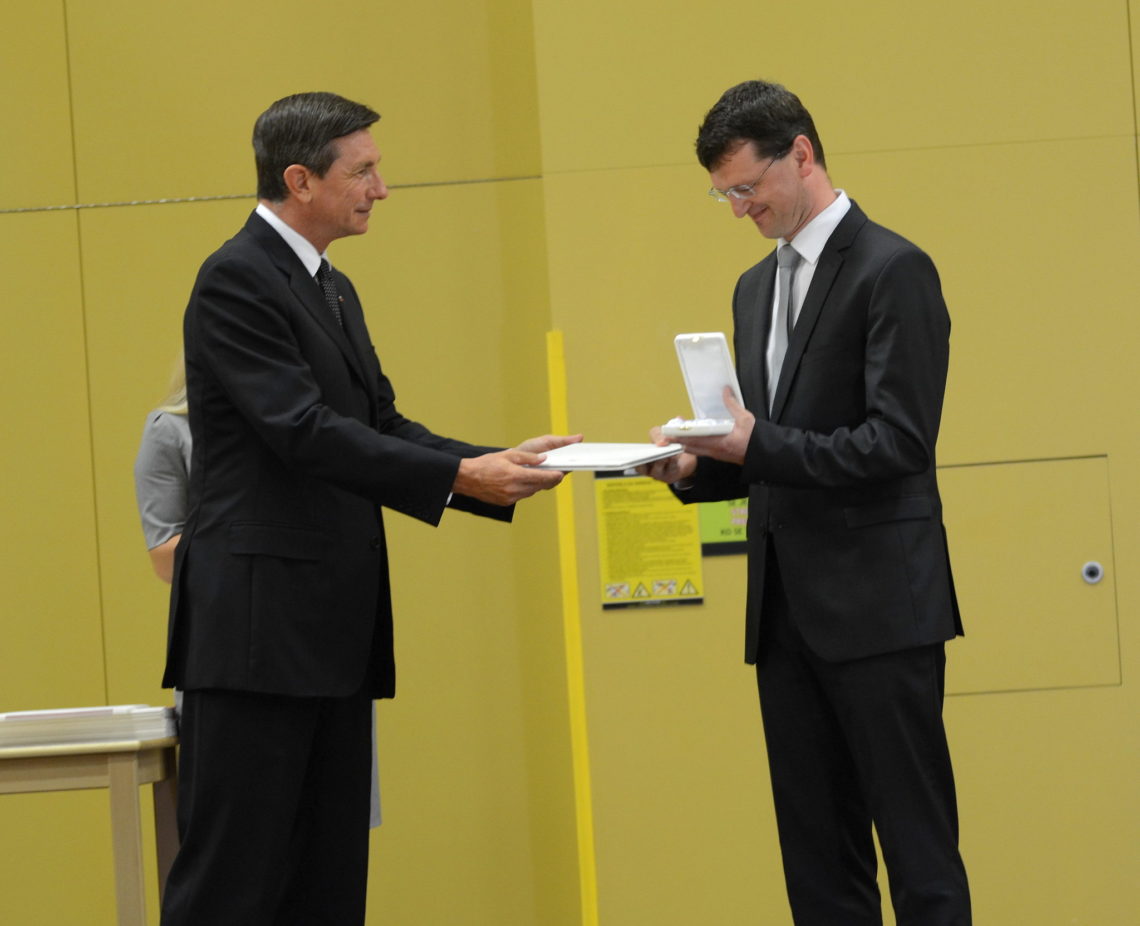
President Pahor granting the silver order to Director Globokar
The celebration of Statehood Day and the end of the school year on 23rd June 2017 was particularly solemn, as the President of the Republic of Slovenia Borut Pahor granted the silver order of merit to St. Stanislav’s Institution for »continuation of a long and prosperous educational tradition.« The order was given on 25th anniversary of re-establishment of St. Stanislav’s Institution and was received by its director dr. Roman Globokar. The school community was honoured by the presence of the Archbishop of Ljubljana Stanislav Zore. The event was attended also by about 800 students and alumni, parents and teachers.
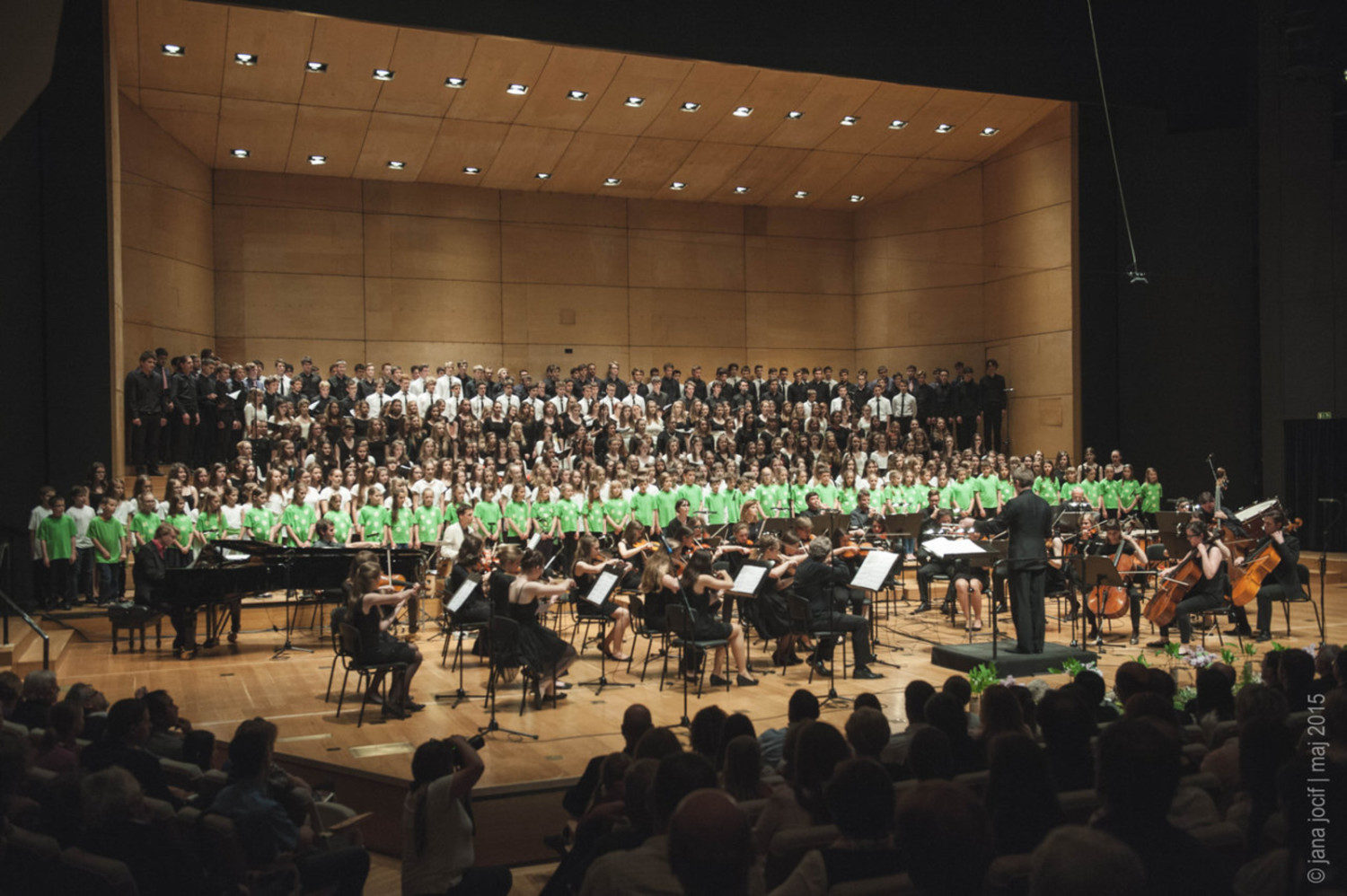
The explication describes St. Stanislav’s Institution as a central education establishment, where the Diocesan Classical Gymnasium is the only Slovene high school, which follows the tradition of integral classical education, teaching Latin and classical Greek. This importantly contributes to preservation of European views in the Slovene context. More than 3.000 alumni have already graduated from this school and they rank among the best in the country. School’s curriculum is varied and rich. Much of attention is also paid to physical and spiritual development as well as active citizenship and critical thinking. The Institution’s principle of functioning fosters open dialogue and active participation. Numerous other activities are being carried out with special care, which enables students to deepen life philosophy and acquire versatile knowledge and skills. Culture keeps a special place through literary creations, drama clubs and the school of fine arts. The most distinguished and developed is music, where students sing in nine choirs and all of them achieve outstanding results at regional, national and international levels.
Director Globokar extended his appreciation to all those who have co-created the Institution’s story in the last 25 years. »St. Stanislav’s Institution with six schools represents a fruitful intertwinement of creativity, enthusiasm, innovation, eagerness of youth, good relationships and success in various fields of life. Every single worker’s contribution to this lively vibration is priceless and valuable.« He added that the silver order of merit is an extra encouragement for further active participation and enrichment of Slovene school system and culture in general.
Prior to the celebration, President Pahor and Ms Pečar visited with Director Globokar the newly open room dedicated to the memory of former Archbishop Alojzij Šuštar. /compiled and translated by Lily Schweiger Kotar/
Composer and conductor Damijan Močnik wrote a composition entitled JERUSALEM for St. Stanislav Girls’ Choir to be performed at 11th World Symposium on Choral Music in July 2017 in Barcelona. Here are some of Močnik’s reflections on the piece: “Jerusalem means »the city of peace«; however, the city reflects the world we live in. Every morning it wakes up in restlessness, conflicts and hatred. The idea for the composition and its final form were maturing through numerous talks with my friend and conductor Helena Fojkar Zupančič and at rehearsals with the wonderful St. Stanislav Girls’ Choir of the Diocesan Classical Gymnasium.
In the composition JERUSALEM I have used the name of the city in several languages (Egyptian, Aramean, Akkadian, Hebrew, Arab, Greek, Latin and Slovene) and applied the sections from Psalm 121 in 5 languages (English, Hebrew, Arab, Latin and Slovene). As Jerusalem is the holy city for the three biggest monotheistic religions, I have used different images deriving from Jewish, Christian and Muslim music. What has been created is a picturesque and powerful fresco, which depicts on one hand, an enormous contrast, but on the other, a fervent wish for peace.” /Damijan Močnik/
Within the framework of the 49th International Writers’ Meeting in Bled, Slovenia, The Diocesan Classical Gymnasium had the honour of hosting Bluma Finkelstein, a poet and professor of French Literature at the University of Haifa in Isreal. The meeting with third year students took place on 10th May 2017 at 11.00p.m. in the A. Breznik School Library.
Bluma Finkelstein was born in Romania, but was forced to leave her homeland at an early age and has been leaving in Israel ever since. She is an active freedom fighter and has received several prizes for her engagement in this field. Bluma Finklestein has published 25 collections of poems, and 3 essays on Christian- Jewish dialogue. The moderator of the event was Ignacija Jarc Friedl, to who we are most grateful for bringing such a distinguished guest to St. Stanislav’s Institution. We are most grateful for such a lively meeting with the acclaimed poet and the discussion on the current issues as well as simply enjoying the good poetry reading./Lily Schweiger Kotar/
Warning: Undefined property: WP_Error::$term_id in /var/www/vhosts/stanislav.si/en.stanislav.si/wp-content/themes/stanislav/sidebar.php on line 132
Latest posts under Warning: Undefined property: WP_Error::$cat_name in /var/www/vhosts/stanislav.si/en.stanislav.si/wp-content/themes/stanislav/sidebar.php on line 136
: